Showing posts with label art. Show all posts
Saturday, February 28, 2015
Louisville Kentucky Art Deco Skyline
Louisville Kentucky Art Deco Skyline view south across the Ohio River from Indiana, with Belle of Louisville Steamboat. Made in Adobe Illustrator.
Prints available at: Fine Art America
Monday, February 9, 2015
Madison Wisconsin Art Deco Skyline
Madison, Wisconsin art deco skyline poster created in Adobe Illustrator.
Prints available at: Fine Art America
Saturday, January 31, 2015
Chicago Art Deco Skyline
Art Deco Skyline of Chicago that I made in Adobe Illustrator. It is adapted from the small image of an old postage stamp that I found online. I love art deco architecture and styling from the 1930s.
Prints available at: Fine Art America
Wednesday, January 29, 2014
The Seeker
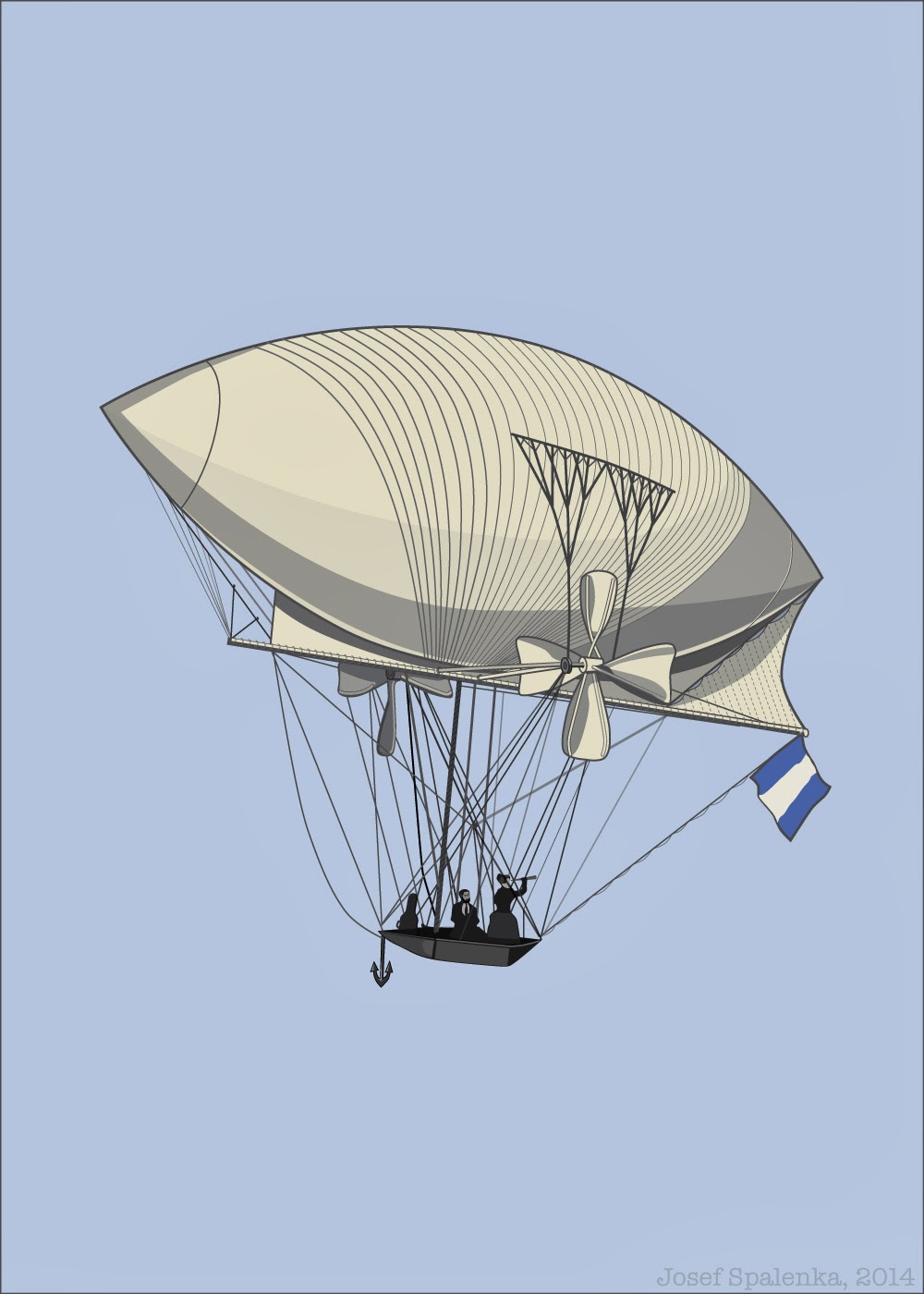
I wanted to practice my Adobe Illustrator skills, which is always incredibly useful for making vector graphics for slides and figures. To stretch my skills, I attempted to make a vector image based on a relatively complex piece of engraved art. It is from the label of a bottle of German Riesling wine that Danielle found at Woodman's Market. It took a long time to make all of the cables and rigging, and get shapes of all of the curves right with the pen tool!
And below is the original image from the wine bottle label. The above image was made by more or less artfully tracing this wine label in Illustrator. The wine was pretty good, but the label art was so cool!
The Seeker German Riesling wine bottle label
A new version of "The Seeker" with a more colorful sky.
(Edited April 24, 2014)
Sunday, January 19, 2014
The Art of Learning New Tricks as an Old Dog: feedback and taking lots of turns
It becomes increasingly difficult to learn new things as an adult. I am convinced, however, that this observed fact is not because the adult mind is less adept at learning than it was during childhood or adolescence. It is instead because adults have, over the course of their lives, developed a complicated web of phobias, bad habits, and misconceptions about themselves that puts barriers in the way of learning new things.
By the time you reach around 30 years old, it is easy to simply conclude that it's a matter of genetic destiny that you are no good at certain skills and never will be. You simply say "I can't draw," or "I can't write well," or "I'm no good at Spanish," and leave it at that. Once that type of self-talk becomes part of your identity, and you become "the sort of person who can't draw or write well," it is so easy to spend the rest of your remaining life self-fulfilling that prophecy. You will never bother to get even 10% better at drawing, or writing, or speaking español through the power of deliberate practice the way you might have when you were a foolish and uninhibited youngster.
The best way to learn something is to try it out and fail miserably, get feedback and advice from an expert source on how to do it a little better next time, and then take another turn. Take lots of turns. This is why it is valuable for everyone to try to learn a musical instrument at some point in their lives. Music learning teaches the power of deliberate practice over a long period of time, and the results of practice are apparent in a particularly objective way for music compared to other complex creative skills. When you started learning music you probably couldn't clap a tricky rhythm, and then you worked at it deliberately for a while, and then you could do it a little better, and eventually it was flawless and automatic. The progress over time for musicianship is obvious because many typical practice exercises on rhythm and pitch can be "right or wrong" in a way that has no easy analogue for more subjective creative tasks such as acting, writing, storytelling, painting, or filmmaking. Once you prove that you can use deliberate practice to improve your music skills, you can use that success to apply deliberate practice to anything.
I recently started reading The Improv Handbook-The Ultimate Guide to Improvising in Comedy, Theatre, and Beyond, by Tom Salinsky and Deborah Frances-White. My initial reasoning for wanting to study the techniques of improvisational theatre is that I could use the ideas and apply them towards having better telephone conversations, answering and asking better questions at job interviews, thinking faster on my feet, and delivering better speeches in public.
However, as I started reading the Improv Handbook, I came across a series of passages that described the barriers to learning new things that are endemic in adults, barriers to learning any new thing. I found the following passages so wonderful and compelling that I will quote them here in full:
As such, any feedback is always welcomed here: any comments on writing style, the content of the ideas, what's boring, what's not. Does something I wrote make you angry? What do you find interesting? Pretentious? Condescending? Annoying? Uplifting? Poetic? Let me know, and I will certainly appreciate it.
"Portrait of an Extraordinary Musical Dog" by Philip Reinagle (1805)
By the time you reach around 30 years old, it is easy to simply conclude that it's a matter of genetic destiny that you are no good at certain skills and never will be. You simply say "I can't draw," or "I can't write well," or "I'm no good at Spanish," and leave it at that. Once that type of self-talk becomes part of your identity, and you become "the sort of person who can't draw or write well," it is so easy to spend the rest of your remaining life self-fulfilling that prophecy. You will never bother to get even 10% better at drawing, or writing, or speaking español through the power of deliberate practice the way you might have when you were a foolish and uninhibited youngster.
The best way to learn something is to try it out and fail miserably, get feedback and advice from an expert source on how to do it a little better next time, and then take another turn. Take lots of turns. This is why it is valuable for everyone to try to learn a musical instrument at some point in their lives. Music learning teaches the power of deliberate practice over a long period of time, and the results of practice are apparent in a particularly objective way for music compared to other complex creative skills. When you started learning music you probably couldn't clap a tricky rhythm, and then you worked at it deliberately for a while, and then you could do it a little better, and eventually it was flawless and automatic. The progress over time for musicianship is obvious because many typical practice exercises on rhythm and pitch can be "right or wrong" in a way that has no easy analogue for more subjective creative tasks such as acting, writing, storytelling, painting, or filmmaking. Once you prove that you can use deliberate practice to improve your music skills, you can use that success to apply deliberate practice to anything.
On Taking Lots of Turns
I recently started reading The Improv Handbook-The Ultimate Guide to Improvising in Comedy, Theatre, and Beyond, by Tom Salinsky and Deborah Frances-White. My initial reasoning for wanting to study the techniques of improvisational theatre is that I could use the ideas and apply them towards having better telephone conversations, answering and asking better questions at job interviews, thinking faster on my feet, and delivering better speeches in public.
However, as I started reading the Improv Handbook, I came across a series of passages that described the barriers to learning new things that are endemic in adults, barriers to learning any new thing. I found the following passages so wonderful and compelling that I will quote them here in full:
...The words "Can I have a volunteer?" often ignite feelings of fear and anxiety. People who have paid to be at [a] class, or have sometimes paid for three years of drama school, will often avoid eye contact with the teacher when the request is made.
It is not always like this, however. On some occasions, if a volunteer is asked for, every single person puts their hand up and some actually rush forward. That's when those people are children.
Children approach playing games, or doing exercises or being given the chance to try something new, very differently from adults. Children approach these situations with one mission, and that mission is to have lots of turns. They sometimes actually rate their success that way, saying something like "I had four turns and Charlie only had three—I win!"
Adults are very different. We want to sit back, assess—from our seats!—whether we'd be any good at the task in question. If we think we'd be successful at it, then and only then will we want a turn. If we think it is something we would not be good at, we would usually prefer to have no turn at all.
Children want lots of turns, but adults want one perfect turn.
As adults, we've already decided what we're good at and what we're bad at, and we only want to have turns at things we're already good at. We've met lots of people who've told us they can't draw, but none of them was seven. All children think they're brilliant artists and want their drawings displayed on the refrigerator. As adults, even if we secretly think we can draw, we hide our sketches away under the bed: "Don't look at those—they're just some silly things I was doodling." The thing is, we all were those children. We believed we were great artists, we sang and danced when we were happy and acted out cops and robbers for hours. No one ever stopped and said "I'm not a very good robber. I've run out of ideas. I think I need to research my character." We always had endless ideas. Endless positivity. Endless faith in our own talent. What happened to us?
One answer is: our education. We hope at least that your education was free because, wherever you got it, it has screwed you over and transformed you from someone who volunteered fearlessly and believed in your own creative abilities into someone who is unwilling to get up at all in case "you make a fool of yourself," and who claims they "can't" sing, dance, draw, act or speak in public and who has no imagination.
When you're at school, if the teacher tells the class to write an essay and everyone else is writing, and you're sitting there all Zen and relaxed, thinking about your essay, what will happen? The teacher will shout at you. She'll say "You! You're not even trying." She would know if you were trying because trying looks like something. If your shoulders are hunched and you look worried and a little ill, then the teacher will probably come and do it for you. We learn to look anxious before we do things—like we're not up to it.
We also tend to punish ourselves after we do things. Two adults will volunteer for something, and after they finish they'll make a physical gesture of apology which says to the room: "No need to mention it—we know it wasn't very good." Maybe this is because we teach our children to punish themselves if they suspect they've failed. When you're a kid, if you're washing dishes and you break a plate and you say "Well, never mind, everyone drops things from time to time," and you clean it up in a relaxed and happy fashion, your mother will shout at you. This in our society is a "bad attitude." A "good attitude" is to cry and feel worthless. Then your mother will say "Never mind, darling, it was only an accident," and then clean it up for you. Therefore, as adults, we anticipate this; we've learned to. We look anxious before and after everything we do to avoid punishment from others.
This means we come to any learning opportunity feeling tense and anxious. If that was a good state for learning or creativity that would be great, but unfortunately you're less likely to be good at learning—or any creative pursuit—with a gun pointed to your head. The fact is you're the most able to learn, create and improvise when you're most yourself. Think about it: Are you more witty, sparky and full of ideas when you're with your oldest friends and a bottle of wine or when you're on a job interview? Your inner improviser is far more likely to be with you when you're relaxed.
It follows that the people who are most successful at learning to improvise are those who are most relaxed. We tell our students that their only mission is to have lots of turns and see if we're worth our money. We say "I'm the only one who's shown up claiming to be an expert and therefore I'm the only one who should be nervous." If they can already do everything we show them very well, that makes our job very difficult. As teachers it's our job to find things the students can't do and show them how to do them. Education is not coming to the workshop pre-educated. We tell them "I'm hoping for a very high level of failure in this workshop, otherwise how can I take your money in good conscience?"This blog is primarily a vehicle to engage in deliberate writing practice so that I may become a better writer over a long period of time. I plan to take lots of turns. My intention is to become not only a better writer, but also a clearer thinker, and a more attentive reader than I was when I began. The blog format is better than writing in a secret notebook or diary because the entries are searchable, dated and timestamped, allowing any progress over time to become more apparent (and safer from being lost during a cross-country move). It also allows me to "take lots of turns" writing in a natural way, and experiment with different writing styles and genres. Blog posts can be commented upon, and the traffic results for different articles can be compared to one another, providing a mechanism to get valuable feedback on the quality and interest from the readers. Some day, I hope to be able to write well enough, and write interesting enough things, that I could write a whole book (or several books) and then take your money in good conscience.
As such, any feedback is always welcomed here: any comments on writing style, the content of the ideas, what's boring, what's not. Does something I wrote make you angry? What do you find interesting? Pretentious? Condescending? Annoying? Uplifting? Poetic? Let me know, and I will certainly appreciate it.
Sunday, January 27, 2013
Islamic Astronomer from the Istanbul Old Book Bazaar
I bought this picture of an Islamic astronomer at the Istanbul book bazaar during our honeymoon in Turkey last summer. It is a single page out a of a book that must have once contained many such treasures. Although the text is printed and likely mass-produced (the back side of the page is also completely covered in Arabic text), the image itself is hand-painted. Some of the smallest lines are so delicate, I think they were painted with strokes from a single hair. Although it is not obvious in the scanned image, the telescope and the borders are done in a metallic gold paint that reflects light brightly when held at certain angles. I have since framed it and it now resides in my office, but I felt like it was too beautiful not to share with a wider audience. My guess is it is perhaps about 150 years old, but I really have no idea of its true age, or what the text says.
Wednesday, December 12, 2012
Favorites from the Boston Museum of Fine Arts
Two weeks ago I was in Boston, MA, for the MRS (Materials Research Society) Fall Meeting at the Hynes Convention Center. After the conference was over I was able to spend most of the day Friday at the Boston Museum of Fine Arts. It is a lovely museum.
I took the hour-long "Art of the Ancient World" tour, and then explored the rest of the museum on my own. One thing I learned that I did not previously know is that the Museum of Fine Arts (also known as the MFA) has one of the largest and most exquisite collections of ancient Egyptian art and artifacts in the United States.
In addition to fantastic Egyptian objects, there were many interesting Mesopotamian artifacts in the collection. For example, here is a cylindrical carved seal from ancient Babylon:
The cylinder seal is on the left, and an example of its impression in plaster is on the right. The ancient Babylonians, Assyrians, and other cultures used these seals a bit like bar codes for shipping goods. You rolled these seals into clay or wax as the cargo leaves, and you could identify the owner of the cargo at its destination by the presence of the distinctive seal. It is amazing how beautifully and delicately these hard stone cylinders are carved, and they're carved in reverse in order to leave the correct imprints.
I managed to venture away from the ancient art and view some of the famous American and European artworks as well. This famous painting by J. M. W. Turner is called "The Slave Ship." It caused quite the stir when it was painted and was very controversial for the grisly depiction of slave bodies and chains thrown overboard so the slavers could collect on insurance payments for injured and sick slaves who wouldn't be sellable. It was painted in 1840, about 20 years before the breakout of the American Civil War, so slavery was very much a hot-button political issue at the time. This painting probably even sparked a lot of conversations and soul-searching that eventually led to the ending of slavery in America.
Mark Twain was a little critical of the composition of the painting, but his assessment actually hits pretty close to the mark for what this explosion of orangey yellow brown and red color evokes if you sort of squint at it from afar: "Slave Ship - cat having a fit in a platter of tomatoes." I thought it was kind of cool that Mark Twain definitely stood in front of this painting during the 19th Century, though it was probably hanging someplace else at the time.
I really got drawn in by this painting of Berber King Mulay Ahmad painted by Peter Paul Rubens in 1609. The artist must have loved this painting himself, because he kept it in his own collection for more than 30 years. I don't know what it was about this guy, but the glistening of his eyes and the shimmery quality of the fabrics really got me staring.
This final painting is really fun. It is called "Museum Epiphany III" by Warren Prosperi. It's a bit of a "meta" art work because it is a painting of people viewing all the 19th century American artwork in the beautiful gallery surrounding it. It is a bit like looking in a mirror that's not changing, or a photograph taken on a particular day in the gallery. If they ever change the arrangement of works in the room, or the colors of the wallpaper, the effect wouldn't work anymore. It is the only recent painting in the room (painted in 2012) and it kind of sneaks up on you in the middle of the other works with gratifying results.
I took the hour-long "Art of the Ancient World" tour, and then explored the rest of the museum on my own. One thing I learned that I did not previously know is that the Museum of Fine Arts (also known as the MFA) has one of the largest and most exquisite collections of ancient Egyptian art and artifacts in the United States.
These masterfully done paintings are from the interior of the wooden outer coffin of Djehutynakht, who was a governor during the Middle Kingdom of Egypt (2040-1640 BC). Apparently this piece is notable for the onion bulbs in the lower middle, which have shading to indicate their roundness, and the darker coloration for Djehutynakht's left leg (seated), again indicating some depth. This is one of the earliest examples of shadow and depth in painted art. What is also amazing is that this is on the inside of a sealed coffin, so it wasn't really artwork meant for the living to admire.
These wooden ship models are also from the tomb of Djehutynakht. I am always astounded that little delicate pieces of wood like this can not only survive for millennia, but they look like they could have been made yesterday.
I managed to venture away from the ancient art and view some of the famous American and European artworks as well. This famous painting by J. M. W. Turner is called "The Slave Ship." It caused quite the stir when it was painted and was very controversial for the grisly depiction of slave bodies and chains thrown overboard so the slavers could collect on insurance payments for injured and sick slaves who wouldn't be sellable. It was painted in 1840, about 20 years before the breakout of the American Civil War, so slavery was very much a hot-button political issue at the time. This painting probably even sparked a lot of conversations and soul-searching that eventually led to the ending of slavery in America.
I really got drawn in by this painting of Berber King Mulay Ahmad painted by Peter Paul Rubens in 1609. The artist must have loved this painting himself, because he kept it in his own collection for more than 30 years. I don't know what it was about this guy, but the glistening of his eyes and the shimmery quality of the fabrics really got me staring.
Thursday, November 1, 2012
immagini di tarsia
Tarsia è una tecnica artistica con l'impiallacciatura di legno. Diverso specie di legno hanno diversi colori e modelli, questi offrono contrasto. Per fare le immagini, ho tagliato i pezzi di legno con un affilatissimo coltello, i pezzi si incastrano con colla e nastro adesivo. Questo è incollata su legno compensato, è levigato con carta abrasiva, e rifiniti con olio di tung. L'olio di tung accentua le belle figure nelle venature del legno. Si possono fare ombre con un po bruciando dei bordi dei pezzi di legno con sabbia molto calda.
Ecco un'immagine di un fiore fatto con tarsia. L'ho fatto per mia nonna.
Ecco un'immagine dell "Albero della Vita". L'ho fatto per mio cugino, che è uno studente di biologia.
-- Josef Spalenka
Wednesday, October 31, 2012
Tornerò al violino! (un giorno...)
Un giorno, spero di tornare a suonare il violino. Ho avuto lezioni di violino per sette anni, ma ho preso una pausa per concentrarsi sul completamento il mio dottorato. Faccio voto di suonare il violino di nuovo presto!
Ecco una pittura digitale che ho fatto. Raffigura una giovane donna, suonare il violino, con un tocco di magia. Ho dipinto due anni fa.
Violinista Dipinto, La mia pittura violinista
-- Josef Spalenka
Thursday, October 25, 2012
Sculptris
Stasera, ho scoperto un programma per computer di scultura 3D. Si chiama "Sculptris," ed è gratuito per il download. Ho giocato con il programma per quindici minuti, e ho capito subito è molto semplice, facile e intuitivo. Ho sempre voluto fare arte digitale 3D! Sono entusiasta di utilizzare questo programma per lavoro e divertimento.
via Richard Potter (link)
Sunday, September 30, 2012
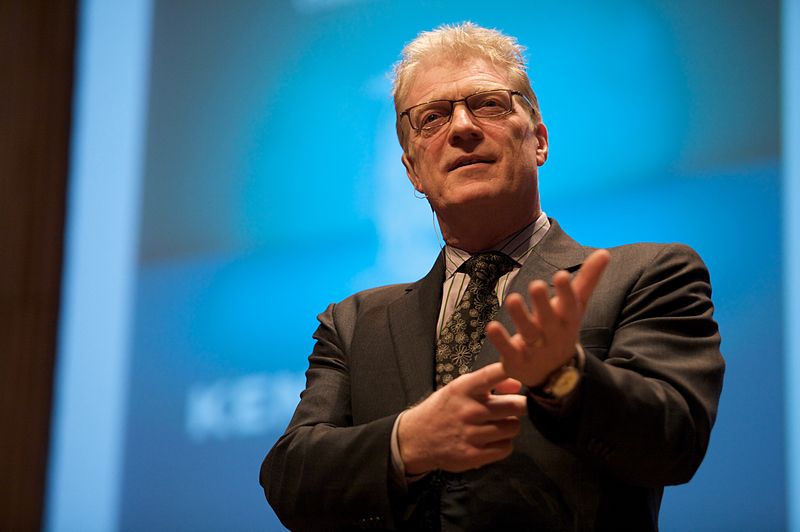
Sir Ken Robinson: la creatività, la verità e la bellezza
Questo pomeriggio, abbiamo ascoltato un discorso di Sir Ken Robinson. È un esperto nell'educazione, è stato dal Regno Unito, originariamente. Ha parlato su come migliorare la creatività nel sistema educativo. È stato anche molto divertente!
Tuttavia, credo che la creatività, mentre è molto importante, i classici metodi di apprendimento, per esempio memorizzazione meccanica, ripetizione e la practica sistematica sono importanti anche. Credo che dobbiamo tutti anche avere conoscenze elementari di matematica, scienze, lettura, scrittura, storia, e le arti, insieme a coltivando la creatività.
-- Josef Spalenka
Saturday, September 29, 2012
Arte conservazione lezione
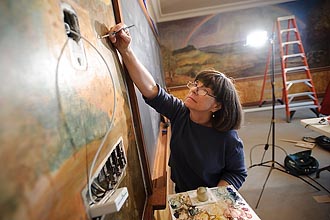
Oggi, abbiamo ascoltato una lezione sulla conservazione delle pitture murali storiche. I murales sono stati dipinti da John Steuart Curry. E 'stato una "artista in residenza" al l'Università di Wisconsin durante i 1940s, nel dipartimento di chimica agricola (biochimica). I murales sono bellissimi, ora che la costruzione e la conservazione è completa.
-- Josef Spalenka
Subscribe to:
Posts (Atom)