Showing posts with label history. Show all posts

Saturday, January 31, 2015

Chicago Art Deco Skyline

Chicago Art Deco Skyline Josef Spalenka Adobe Illustrator

Art Deco Skyline of Chicago that I made in Adobe Illustrator. It is adapted from the small image of an old postage stamp that I found online. I love art deco architecture and styling from the 1930s.

Prints available at: Fine Art America

Sunday, April 6, 2014

Science Cats! Volume 2

This is a continuation of the Science Cats! theme I started last month. If you enjoy these, feel free to share them with friends and family, and make suggestions or requests in the comments.

Rutherford scattering experiment 1911 Science Cats! Chloe cat Josef Spalenka
Illustration of the classic Rutherford scattering experiment in which alpha particles (helium nuclei) elastically scatter from the nuclei of gold atoms (elastic scattering means the lighter α particles bounce off of the heavy Au atoms like billiard balls without losing their speed). In 1911, Ernest Rutherford used this experiment to prove that most of the mass of an atom is tightly concentrated in a tiny core nucleus in the atom, falsifying the previous "plum pudding model" of the atom in which the electrons are dispersed throughout a smeared-out positive spherical volume like blueberries in a muffin. The Rutherford Model for the atom was later updated in 1913 by the Bohr Model, which begins to hint at the first quantum mechanical picture of the atom. In this incarnation of the Rutherford scattering experiment, Chloe serves as the source of α particles.

Nicolaus Copernicus science cats heliocentric heliocentrism Jan Matejko Josef Spalenka
Polish astronomer and mathematician Nicolaus Copernicus formulated and published the heliocentric model in the first half of the 16th century, forever changing how humanity viewed its relationship to the Cosmos. The awe and majesty of this newly expanded cosmic perspective was beautifully captured in this 1873 oil painting by artist Jan Matejko (also Polish). In the foreground of the painting, Chloe plays with a rope and a random wooden pulley thing, completely oblivious to beauty and grandeur of the rest of the universe.

Antoine Lavoisier Marie-Anne Pierrette Paulze chemistry Chloe science cats Josef Spalenka
Chloe disrupts a tender moment between Antoine Lavoisier and his wife (and scientific collaborator) Marie-Anne Pierrette Paulze. Lavoisier is widely considered to be the founder of modern quantitative chemistry. He recognized and named the elements oxygen and hydrogen, predicted the existence of silicon, debunked the widely-held but incorrect phlogiston theory of combustion and oxidation, and played a major role in constructing the metric system. In spite of his incredible and far-reaching contributions to humanity, he was summarily guillotined in the aftermath of the French Revolution and overshadowed by politicians and war heroes in the history textbooks. So it goes.

Science cats Chloe Robert Goddard rockets rocketry liquid-fueled Josef Spalenka
"Professor Goddard does not know the relation between action and reaction and the need to have something better than a vacuum against which to react. He seems to lack the basic knowledge ladled out daily in high schools." -New York Times editorial from January 13, 1920, which was famously retracted in 1969 after the Apollo moon landing. Robert Goddard was ridiculed by the unimaginative fools in the press throughout his career and as a result kept much of his groundbreaking work private. His liquid-fueled multistage rockets were major milestones in the development of rocketry and the advance of space exploration.

If you liked these, be sure to check out Science Cats Volume 1!

Saturday, March 15, 2014

Science Cats! Volume 1

Isaac Newton white light spectrum optics cat chloe Cosmos Josef Spalenka
Sir Isaac Newton and assistants explore the visible light spectrum, refraction, and optics in 1666.

I am making a series of pictures celebrating the history of science and technology by inserting our cat, Chloe, into photoshopped science-themed images. They mostly represent themes in the new episodes of Cosmos: A Spacetime Odyssey. I will periodically add more pictures to this gallery as new episodes of Cosmos air on television, and as I think of new ideas (or get any interesting requests). Enjoy the science cats!

Watson and Crick DNA double helix model 1953 Chloe cat science Josef Spalenka
Chloe, Watson, and Crick demonstrated the first correct model for DNA in 1953. Francis Crick points at the double helix model while James Watson and Chloe look on. Rosalind Franklin (not pictured) provided crucial X-ray diffraction evidence, but sadly was not awarded a share of the 1962 Nobel Prize with the pictured scientists.

Chloe cat Cosmos Albert Einstein pipe smoke Josef Spalenka
Chloe and Albert have a contemplative smoke break together and think about the theoretical implications of curved space-time.

transistor electronics 1948 William Shockley John Bardeen Walter Brattain Bell Labs Chloe Cat Josef Spalenka
The September 1948 cover of Electronics Magazine showing the inventors of the first transistor in their workshop at Bell Labs: John Bardeen (background with glasses), Walter Brattain (right with mustache), and William Shockley (seated pretending to work). The three men would later share the 1956 Nobel Prize in Physics. The development of the semiconductor transistor ignited the computer revolution and directly led to the domination of cat pictures on the internet. Shockley later founded Shockley Semiconductor in Mountain View, CA, effectively establishing Silicon Valley.

Marie Curie radioactivity radium polonium Chloe cat science cosmos Josef Spalenka
Marie Curie discovered the radioactive elements radium and polonium in 1898, the latter of which was named after her native homeland of Poland. She shared the 1903 Nobel Prize in physics with her husband, Pierre Curie, the French physicist Henri Becquerel, and their mischievous lab cat Chloe.

Tiktaalik chloe cat science evolution Neil Shubin Cosmos Josef Spalenka
*boop* Chloe travels 375 Million years back in time and encounters Tiktaalik, an excellent example of a transitional fossil which has mixed characteristics of both fish and tetrapods. As Chloe learned in the excellent book, Your Inner Fish (written by Tiktaalik discoverer Neil Shubin), the anatomy and physiology of both cats and humans shares much in common with their fishy ancestors.

gravitational lensing effect cat galaxies Hubble Chloe Josef Spalenka
A pair of distant cat's eye galaxies are magnified and distorted by the gravitational lensing effect of the Large Red Galaxy (LRG 3-757) in the foreground.

cation cat Chloe carbonate Cosmos "dichloe carbonate" Josef Spalenka
Artist's depiction of dichloe carbonate ions in solution. Originally made for Cosmos episode 2: "Some of the Things That Molecules Do."

Chloe cat Cosmos Helix Nebula space FOX Purrrfect Josef Spalenka
Chloe the cat in front of the Helix Nebula, which is used in the Cosmos logo.
Originally made as a cheesy ad for Cosmos episode 1: "Standing Up in the Milky Way."

Chloe cat science cats! cardboard space shuttle Atlantis costume Halloween Josef Spalenka
The photograph that inspired this series. Chloe inside my cardboard Space Shuttle Atlantis costume from Halloween 2011 in Madison, Wisconsin.

I hope you enjoyed these images of our cat, Chloe, reveling in the wonders of science and exploring the Cosmos! Let me know in the comments if you have any ideas or requests for future "Science Cats!" images, and I can add them to Science Cats Volume 2. And feel free to copy, link, and share with your friends, family, and coworkers!

Friday, February 21, 2014

Paddle Your Own Canoe


Yesterday I started listening to the Audiobook Paddle Your Own Canoe, "One Man's Fundamentals for Delicious Living." It is both written and narrated by Nick Offerman, best known on television as Ron Swanson from Parks and Recreation. It's because of works like these that audiobooks are a valuable format and can sometimes surpass the experience of reading the book they are based on. There is something really special about an audiobook that is read by its own author, when it's done really, really well. And Offerman surely does it well. The only other author I can think of who can regularly pull off this feat is Neil Gaiman.

I don't have any more cogent thoughts than that for now. Perhaps once I've finished the audiobook, I will update this stubby article with some important thoughts about the philosophy of eating barbecued red meat and how to make your own way as a nonconformist man in modern America.

Tuesday, February 11, 2014

Thoughts about Boxes from the Louisville Big Four Bridge


The ramp up the Big Four Bridge looking west towards Downtown Louisville

Forty-two workers perished while constructing the Big Four Railroad Bridge between 1888 and 1895. It served railway, industrial, and passenger traffic until 1969. And then it sat, idle and unused for forty years. Today, the Big Four Bridge is one of the longest pedestrian-only bridges in the world and spans the Ohio River between Louisville, Kentucky and Jeffersonville, Indiana. On either side of the bridge, gently sloping ramps spiral down into lovely new riverfront parks built on former industrial land and shipyards. When strolling the bridge and imagining the bustling riverboat traffic passing beneath the massive iron spans, imagining the brawling dockworkers, the shouts of factory men, the fading smells and sounds of the riverside stockyards, one wonders. What changed?

Why are there no longer so many chemical refineries, textile mills, riverboats and dockworkers hawking their trade along America's inland riverways? Why are so many inland riverfront parks being built on areas that were formerly railroad warehouses, brothels, and piers in cities spanning from Portland to New York? Why are the old warehouses being converted into chic industrial lofts and trendy restaurants, or lying abandoned, instead of housing wares? What changed in the 20th century to fundamentally rearrange the geographic relationship between ports and cities and labor and nations? When asked most people will grumble something about cheap foreign labor. But I think the answer, in large part, is containers.

The former riverboat and boxcar railroad transportation network of the late 19th century and early 20th century has been almost entirely displaced by multi-modal shipping, in which 40-foot standardized steel containers are seamlessly whisked between giant ocean-going container ships, specially designed freight railways, and trucks traveling America's interstate highways. It wasn't always like this.

The Box: How the Shipping Container Made the World Smaller 
and the World Economy Bigger [Left]. The Big Four bridge [Right].

According to The Box by Marc Levinson, starting in the late 1950s the humble steel shipping container revolutionized and reorganized the world economy. Prior to that time, industry often clustered near waterfronts in large port cities in order to minimize costs and time delays for receiving raw inputs and for shipping out finished goods for export. Loading and unloading ships was a labor intensive, time consuming, and dangerous process. Goods came in all shapes and sizes, from bunches of bananas, to barrels of liquor, to hogsheads of tobacco, to crates of medical supplies, to bales of cotton. Dockworkers would quarrel, frequently strike for increased wages, lobby for special protections to prevent competition from immigrant dockworkers, and often endure boom and bust cycles of too much work to handle or no work at all. Theft of dockside merchandise was rampant. Ships could languish tied to the docks for weeks, waiting to exchange cargo and set sail again. The romance of this hustle and bustle life of the wharf-side denizens has been told again and again in literature and in cinema. But the story of the enormous economic inefficiencies of the old way, and the revolutionary change brought about by the extremely low cost of modern container shipping, I think is widely under-appreciated.

Dockworkers unloading bananas at the wharves in New York in 1905
[Photo from Shorpy.com]

Longshoremen loading the Sternwheeler Georgia Lee 
with mixed cargo in Louisville, KY (1905)
[photo from Shorpy.com]

Today container ports can be largely automated and require relatively little human labor per ton of cargo to handle the containers. The turn-around time for a modern ocean-going container ship is measured in hours, not days or weeks. The resulting economic bonanza brought about by low-cost shipping, reduced theft and damage, and increased shipping speed has been one of the main driving forces reshaping the global economy. The reason for the shift of manufacturing capacity from Europe and America to Asia was not just about changes in the global costs of manufacturing labor, it was also about fundamental changes in the global costs of shipping.

A crane loading a container ship at the Port of Colombo in Sri Lanka

People often forget that humble innovations that completely change the living patterns of the whole world aren't always sexy, and they aren't always fast. World-changing ideas are not just about computers and rocket ships. It took half a century or more for the revolution in containerized shipping to rearrange the destinies of the waterfronts of Manhattan and Shenzhen, and launch those locations into completely different historical trajectories.

As you gaze down the Ohio River from the span of the Big Four pedestrian bridge in Louisville, or cast your eyes along the Thames from the base of the Tower Bridge, remember that we may have lost a little bit of the romance of the Dickensian docks and the Mark Twain riverboats. But we have gained so much more in livable city waterfronts, beautiful riverfront parks, less expensive imported goods and raw materials, and an increasingly integrated and thriving world economy. And for that, I'm thankful for The Box.

February Sunset at the Big Four Bridge in Louisville, Kentucky


Sunday, February 9, 2014

End the War Against Preserved and Processed Foods!

As I was reminded by a recent article about the historical trajectory of orange juice in America's food supply, I am continually baffled by the war being waged against food "processing" and food "preservatives." If it can be shown that there are no adverse health consequences, and the product tastes rather good and people like to buy it, and it's much cheaper than "fresh and unprocessed" food, then why demonize a product for lasting a long time on the shelf or for being "overly processed"?

Some heroic highly processed and overly preserved foods

This "processing and preservatives" talk is always conflated with the problem of "the product contains too much sugar," or "the product contains too little nutritional value," which I definitely understand and sympathize with. I get it that orange juice naturally contains lots of sugar, regardless of the date and location the fruits were harvested, or whether aromatic citrus oils were added back into the juice to improve the flavor after a long storage time. I get it that Twinkies contain little in the way of nutritional value for growing children. But will the self-appointed food police concede that many foods can have a very long shelf life, be highly processed with many artificial industrial-scale steps, and yet still contain lots of nutrients and not very much sugar? How about a can of tomato paste that was processed in a factory and "boiled to death," or canned tuna "which has been patiently sitting in storage sometimes for more than a year"? Boiling food to death, putting it in air-tight cans or jars, and eating it over a year after it was harvested from the field or the orchard or the ocean is a supremely amazing achievement of human ingenuity. People ought to be tickled with joy each time they drink a glass of pretty-decently-tasting orange juice, in Chicago or Denver or Boston during a frigid February morning, for just the price of a few measly quarters. Instead they grumble and look out their window at the snowy landscape, and wonder why they aren't instead treated to the sweet nectar of a freshly hand-plucked and hand-squeezed fruit.

Some people complain that "processed foods" are chock full of high-fructose corn syrup and other ingredients that they would like to avoid. However, the presence of high-fructose corn syrup in food has little to do with the number of processing steps required to make the product at a large cost-effective scale, or the desire to preserve and store food for a long time. Instead, corn syrup is put into foods because it is much cheaper than alternative sweeteners such as cane sugar, and people love inexpensive food. People crave sweetness because they are built by evolution to desire high-calorie sweetened foods, which were rare treats in prehistoric nature. No demonization of preservatives or demonization of complicated multi-step industrial processing need enter into this part of the food supply discussion.

Some people complain that they don't like processed or preserved foods because "they have no idea what's in it." I've got news for you, you probably have no idea what's in most of the things you ingest. Most people think of a "roasted coffee bean," for example, as a magical nature product provided by Mother Earth, rather than as a complex cocktail of chemicals in various proportions. Some of the natural chemical constituents of roasted coffee beans are toxic and carcinogenic (but they exist at very low harmless concentrations). If the scientific names of all the chemical components in your all-natural skinny hazelnut macchiato were listed on the back of the cup, they would make your head spin.

Highly preserved and industrially processed foods are simply amazing. They allow us to even out the food supply both geographically and seasonally, and provide low-cost sustenance to people who would have in ancient times suffered a lack of nutrition or even starvation. How quickly people forget that cheese, beer, and wine, those cornerstones of western food culture, were initially methods to "highly process and highly preserve" excess milk, grain, and grapes during bounteous times, in order to stockpile calories and nutrients for leaner times...even stockpile them for many years after the initial harvest. Why did ancient humans bother to invent these things? Why did humans bother to invent beef jerky, and bacon, and salami? It wasn't because some scary corporation thought it would be fun to feed children a bunch of "nitrates and nitrites."

Often, the alternative to eating a highly processed and highly preserved food, or the alternative to eating a food that has traveled hundreds of miles on a truck or on a boat, is to have no food at all. This has been the default situation for mankind for thousands of years, and a situation which has been all but forgotten by the snobbish foodies who complain that frozen concentrated orange juice doesn't taste quite as good as the fresh squeezed stuff picked that day from your very own backyard orchard. Now if you don't mind, before I go shovel the snow from my Chicago sidewalk, I'm going to go have a delicious glass of frozen concentrated orange juice and a mug of chemical cocktail coffee to wash down my Minnesota refined flour crepes spread with California processed cream cheese and a dollop of Montana huckleberry preserves.

Tuesday, February 4, 2014

Ghost disproval thought experiments

The following are a bunch of silly things I've wondered when talking to people who are super serious about their belief that ghosts are real. Since the widespread belief in ghosts isn't easily disproven using physical science and direct measurement data, and ghost belief is often deeply rooted in a personal religious belief, it is probably best to just use these types of silly thought experiments when playfully and skeptically talking about ghosts with less skeptical friends and family. It can be a pretty fun discussion for everyone involved, actually!


The Real Estate theorem of ghost disproval

What happens if you bulldoze a "real haunted house" and build a 24-hour Walgreens on the site? Would you now have a haunted 24-hour Walgreens, or would the resident ghost have to relocate to a spooky Victorian mansion in your town's historic district? That story doesn't sound very scary: "Sometimes I see the ghost of a weeping little girl sitting on the edge of my bed. She used to haunt the Old Johnson Place on Elm Street, but she had to move after they built the new Walgreens. That's probably why she's always weeping." I'm going to call this the "Real Estate theorem of ghost disproval."

The temporal theorem of ghost disproval

How come the majority of ghosts tend to be a few hundred years old or less, regardless of the era? You hardly ever see, or hear a good story about a 3,000 year old ghost. Is it because ghosts are usually able to complete their "unfinished business" in a few century time frame? Is it because ancient ghosts either predate the religious tradition that gives them a philosophical foundation, or because extremely old ghosts can't speak English (or whatever the local modern language is)? Is it because, as was hinted by the Real Estate theorem of ghost disproval, ghosts are intimately tied to the structures they inhabit and there are very few usable structures which have survived for more than 3,000 years? It might also be a ghost demographics phenomenon, in that many more people have died more recently than 3,000 years ago than died longer than 3,000 years ago. Therefore ancient ghosts are simply numerically less common than more modern ghosts. Someone on those Ghost Hunters International TV shows should take a spectral census to get to the bottom of this.

The ambient music theorem of ghost disproval

Ghost stories and haunted houses require a certain ambience in order to get the full effect. Typically this is low lighting inside a 19th century house or an abandoned building, low firelight around a campsite, and either silence, or old-timey music such as Big Band, Ragtime, Jazz, or some lonesome piano music. This ambience is maintained because people want to be scared because it's fun...that's the whole point for them. But are there certain types of ambient music and lighting environments in which ghosts simply cannot exist? For example if you had a multicolor laser light show, inside a bright white room with all white walls and white floor with no furniture, and blared Miley Cyrus Party in the USA, is it impossible to be scared by a ghost?

The absurd juxtaposition ghost disproval theorem

Is it possible to be involuntarily haunted by a ghost if you take steps to be absurd or silly to counteract the scariness of the ghost? For example, you could enter a "real haunted house" with everyone in your group dressed in realistic looking dolphin costumes. The absurdity of a group of humans waddling into the old haunted house dressed as a pod of dolphins might be too much for the ghost to handle. It will throw the ghost off her haunting game and will cause her to be too embarrassed to come out and haunt you.


As I think of more silly theorems of ghost disproval I will continue to add them to this list. If you can think of any along the same lines, let me know! I hope to one day collect the definitive internet list of silly ghost disproval theorems.

Monday, February 3, 2014

Coca-Cola reminds America that it is beautiful. Some disagree.

During last night's blowout Superbowl between the Seattle Seahawks and the Denver Broncos, Coca-Cola aired a commercial that was intended to highlight the inclusivity and the beautifully interwoven cultures that make up the ideal of the American Dream.


I thought it was a nice sentiment and an artfully produced piece of marketing, and then thought nothing more of it. But apparently some Americans publicly disagreed on Twitter and other social media platforms, and in ugly fashion.

This type of vehement negative reaction has surprised some people, but as an amateur student of history I am much less surprised. Xenophobia and ingroup-outgroup mistrust and hatred have been the historical norm for millennia. What is amazing when you really think about it is how far humanity has come in just the last few generations, and how the people who make these awful bigoted statements are becoming more and more marginalized. Not long ago awful statements like these on Twitter were rallying cries for elections and popular movements, and printed on the front pages of newspapers, and circulated nationally on pamphlets...not the subject of ridicule and condemnation. One does not have to look far into the historical record to find numerous examples of anti-Irish, anti-Polish, anti-Jewish, and most notably anti-African-American bigotry.

Anti-immigrant propaganda cartoon from 1896

I think the feedback loops inherent in the broadcast platform of Twitter, and the valuable social criticism as exemplified by the Public Shaming tumblr blog, is another reason why the internet is so awesome. I suspect that this internet feedback will quickly bring a about a revolution of thoughtfulness and consciousness-raising, and that this will be a much bigger effect in moving the world forward than most people realize. This type of virtuous cycle used to be a much slower process, and required curious and literate people to encounter books, magazine articles, and have personal relationships and experiences that would have the same effect. Now, people can be taken to task almost instantly for their bigotry and stupidity, and perhaps taken to task by someone all the way on the other side of the world. This is how change happens, and happens fast. How amazing is that?

Friday, January 17, 2014

Cappadocia: Halfway Between Turkey and Tatooine

In the central regions of Anatolia, in the Republic of Turkey, lies the ancient and beautiful region of Cappadocia.  The heart of Cappadocia is the Göreme valley, a lunar landscape of weathered volcanic rock formations called "fairy chimneys," sometimes riddled with ancient dwellings carved directly into the volcanic tuff, bursting like mushrooms from the cracked desert floor.  Although not well-known to most travelers hailing from North America, after seeing a single picture, it takes little convincing that Cappadocia is one of the most mysterious and lovely places on Earth, and well worth exploring.

A courtyard at Cappadocia Cave Suites hotel in Göreme, Turkey

The volcanic tuff has served as a shelter and dwelling place for locals for many centuries. However, in recent years the caves are being converted into luxury hotels where each room is unique, high quality restaurants with a magical ambience, and underground spas where visitors can receive a Turkish Massage in an underground chamber built in the style of a traditional Hamam.

Have a luxurious Turkish Bath at the Kelebek Cave Hotel Hamam

The region is perhaps most famous for its hot air balloon rides, which occur at dawn almost every day of the year (weather permitting).  There are many reputable ballooning operations in Cappadocia, and dozens of balloons fly every day.  However, I recommend Butterfly Balloons because the balloon captains are hilarious storytellers, and such expert pilots that they can softly land the basket of the balloon directly on a small truck trailer from a mile up. You get to celebrate with a toast of champagne and orange juice at the end of every landing.

A view of the Zelve Valley from the basket of a Butterfly Balloon

Nearby Avanos is a center for the production of beautiful handcrafted ceramics.  Firca Ceramics is one of the main workshops, and this family business has been hand-forming and hand-painting artisanal ceramic pieces in the same cave for almost two hundred years.

Inside Firca Ceramic in Avanos, Turkey

A handful of excellent restaurants can be found in Göreme.  If you are ever in the region, don't miss out on Topdeck Cave Restaurant.  It is a completely family-run establishment in which the Father (his nickname is Topdeck) and Mother do the cooking, while their two talkative young daughters take orders and serve the meals.  It's a little difficult to find Topdeck Cave Restaurant in a back alley of Göreme and requires carefully following a small map to find it. However, the food and the table talk with the charismatic and energetic waitresses are well worth the search.

Meals at Topdeck Cave Restaurant

The portion of our Turkish honeymoon that was spent in Cappadocia was the most cherished part of our trip.  I highly recommend a visit to Göreme Valley as part of any trip to Turkey.  And although it may seem a little expensive to ride one of the hot air balloons at dawn, I promise that the experience is well worth the price!

Hot Air Ballooning at Dawn in Cappadocia

Sunday, January 27, 2013

Islamic Astronomer from the Istanbul Old Book Bazaar


I bought this picture of an Islamic astronomer at the Istanbul book bazaar during our honeymoon in Turkey last summer.  It is a single page out a of a book that must have once contained many such treasures.  Although the text is printed and likely mass-produced (the back side of the page is also completely covered in Arabic text), the image itself is hand-painted.  Some of the smallest lines are so delicate, I think they were painted with strokes from a single hair.  Although it is not obvious in the scanned image, the telescope and the borders are done in a metallic gold paint that reflects light brightly when held at certain angles.  I have since framed it and it now resides in my office, but I felt like it was too beautiful not to share with a wider audience.  My guess is it is perhaps about 150 years old, but I really have no idea of its true age, or what the text says.

Saturday, December 15, 2012

Yerkes Observatory: A Wisconsin Science Temple

Did you know the world's largest refractor telescope is located in southern Wisconsin? The Yerkes Observatory was built in 1897 in Williams Bay, on the northern shore of Lake Geneva, Wisconsin.  Although it is now past its prime for making major astronomical discoveries, today it is a really neat museum and education center.  Danielle and I visited it last year, and I thought I would record a few interesting photographs and tidbits here that might not be found on Wikipedia (where you can go and learn that the Observatory and nearby Frozen Lake Geneva were used as filming locations for Chain Reaction (1996), starring Keanu Reeves and Morgan Freeman).  They typically only provide free tours of the observatory on Saturday mornings, so you have to plan ahead a little bit if you want to visit.


The main telescope itself is quite impressive in scale, as you can see compared to the spiral staircase in this photograph.  Don't leave your jacket in the car if it is a cold morning, because the dome is kept unheated.  This is both because it would be too expensive to heat the dome, and to improve the astronomical viewing conditions by avoiding the atmospheric turbulence that would be caused by warm air escaping the open dome by convection.


Even Albert Einstein (middle right) managed to make a pilgrimage to the Yerkes Observatory in 1921.  It is obvious by comparing this photograph to the previous one that the floor is at different levels with respect to the bottom of the dome.  The entire floor in the room is actually a giant elevator.  Depending on the angle of the telescope, the viewing end changes height.  The solution that the engineers devised is to raise and lower the floor to reach the business end.  The electric motors that lift the floor elevator are still in working condition, and you can ride it up and down on the tour.


Here is a picture of one of the massive counterweights and pulleys that helps raise and lower the floor of the observatory.  There are several of these distributed around the circumference of the room.

Yerkes Observatory telescope elevator floor counterweights

The architectural details are fantastic and full of astronomical symbolism, some of which will be described by the tour guide.  It is pretty neat how the lobby hasn't changed very much from how it was at the end of the 19th century.


If you take a tour, make sure to keep an eye out for Spiderman hanging out in the rafters of the dome!


Wednesday, December 12, 2012

Favorites from the Boston Museum of Fine Arts

Two weeks ago I was in Boston, MA, for the MRS (Materials Research Society) Fall Meeting at the Hynes Convention Center.  After the conference was over I was able to spend most of the day Friday at the Boston Museum of Fine Arts.  It is a lovely museum.

I took the hour-long "Art of the Ancient World" tour, and then explored the rest of the museum on my own.  One thing I learned that I did not previously know is that the Museum of Fine Arts (also known as the MFA) has one of the largest and most exquisite collections of ancient Egyptian art and artifacts in the United States.

Djehutynakht onions ancient egypt painting Boston Museum of Fine Arts

These masterfully done paintings are from the interior of the wooden outer coffin of Djehutynakht, who was a governor during the Middle Kingdom of Egypt (2040-1640 BC).  Apparently this piece is notable for the onion bulbs in the lower middle, which have shading to indicate their roundness, and the darker coloration for Djehutynakht's left leg (seated), again indicating some depth.  This is one of the earliest examples of shadow and depth in painted art.  What is also amazing is that this is on the inside of a sealed coffin, so it wasn't really artwork meant for the living to admire.

ancient egyptian wooden ships Boston Museum of Fine Arts Djehutynakht

These wooden ship models are also from the tomb of Djehutynakht.  I am always astounded that little delicate pieces of wood like this can not only survive for millennia, but they look like they could have been made yesterday.

In addition to fantastic Egyptian objects, there were many interesting Mesopotamian artifacts in the collection.  For example, here is a cylindrical carved seal from ancient Babylon:

Carved cylindrical seal from ancient Babylon (left) and its impression in plaster (right)

The cylinder seal is on the left, and an example of its impression in plaster is on the right.  The ancient Babylonians, Assyrians, and other cultures used these seals a bit like bar codes for shipping goods.  You rolled these seals into clay or wax as the cargo leaves, and you could identify the owner of the cargo at its destination by the presence of the distinctive seal.  It is amazing how beautifully and delicately these hard stone cylinders are carved, and they're carved in reverse in order to leave the correct imprints.

I managed to venture away from the ancient art and view some of the famous American and European artworks as well.  This famous painting by J. M. W. Turner is called "The Slave Ship." It caused quite the stir when it was painted and was very controversial for the grisly depiction of slave bodies and chains thrown overboard so the slavers could collect on insurance payments for injured and sick slaves who wouldn't be sellable. It was painted in 1840, about 20 years before the breakout of the American Civil War, so slavery was very much a hot-button political issue at the time.  This painting probably even sparked a lot of conversations and soul-searching that eventually led to the ending of slavery in America.

19th Century Painting MFA Boston Museum of Fine Arts

Mark Twain was a little critical of the composition of the painting, but his assessment actually hits pretty close to the mark for what this explosion of orangey yellow brown and red color evokes if you sort of squint at it from afar: "Slave Ship - cat having a fit in a platter of tomatoes."  I thought it was kind of cool that Mark Twain definitely stood in front of this painting during the 19th Century, though it was probably hanging someplace else at the time.

I really got drawn in by this painting of Berber King Mulay Ahmad painted by Peter Paul Rubens in 1609.  The artist must have loved this painting himself, because he kept it in his own collection for more than 30 years.  I don't know what it was about this guy, but the glistening of his eyes and the shimmery quality of the fabrics really got me staring.


This final painting is really fun.  It is called "Museum Epiphany III" by Warren Prosperi.  It's a bit of a "meta" art work because it is a painting of people viewing all the 19th century American artwork in the beautiful gallery surrounding it.  It is a bit like looking in a mirror that's not changing, or a photograph taken on a particular day in the gallery.  If they ever change the arrangement of works in the room, or the colors of the wallpaper, the effect wouldn't work anymore.  It is the only recent painting in the room (painted in 2012) and it kind of sneaks up on you in the middle of the other works with gratifying results.

Museum Epiphany iii by Warren Prosperi (2012) Boston Museum of Fine Arts, with surrounding gallery context

Sunday, November 25, 2012

Nel Giardino delle Bestie

Ho finito di leggere "Nel Giardino delle Bestie," ("In the Garden of Beasts"), di Erik Larson.  È una storia agghiacciante, e vero, della Germania nazista primo della seconda guerra mondiale.  È spaventoso come le atrocità intensificare, ma il resto del mondo non capisce, fino troppo tardi.  L'ambasciatore americano e sua figlia incontrano molti funzionari infami nazisti, e diventano più reali per il lettore.  Leggi il libro primo che il film di Tom Hanks arrivi!


Saturday, October 13, 2012

Argo

Ieri sera, abbiamo visto un film intitolato "Argo."  Il film, diretto da Ben Affleck, è ambientato in Iran durante l'inverno del 1979/1980.  I governi del Canada e degli Stati Uniti collaborano per salvare sei diplomatici da Teheran.  Per sfuggire al paese, che si travestono da un troupe cinematografica di fantascienza.  È modellato su una storia vera.  Il film è stato ottima, e lo consiglio vivamente!


Wednesday, October 10, 2012

l'ufficio segreto di Google a Madison

Oggi, ho scoperto che Google dispone di un ufficio segreto a Madison.  Si trova in un vecchio magazzino di "International Harvester," un produttore di trattori e macchine agricole.  Danielle ha lavorato negli archivi di questo produttore proprio lo stesso!  È sorprendente che l'ufficio di Google è stato per cinque anni a me sconosciuti!


Apparentemente, l'ufficio segreto di Google a Madison ha dipendenti che sono tifosi del Green Bay Packers:


Saturday, September 29, 2012

Arte conservazione lezione

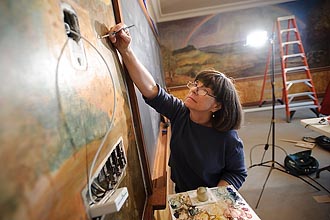
Oggi, abbiamo ascoltato una lezione sulla conservazione delle pitture murali storiche.  I murales sono stati dipinti da John Steuart Curry.  E 'stato una "artista in residenza" al l'Università di Wisconsin durante i 1940s, nel dipartimento di chimica agricola (biochimica).  I murales sono bellissimi, ora che la costruzione e la conservazione è completa.


-- Josef Spalenka